China's IP Landscape in 2025: What Has Actually Changed, What Hasn't, and How Smart US Companies Are Navigating It
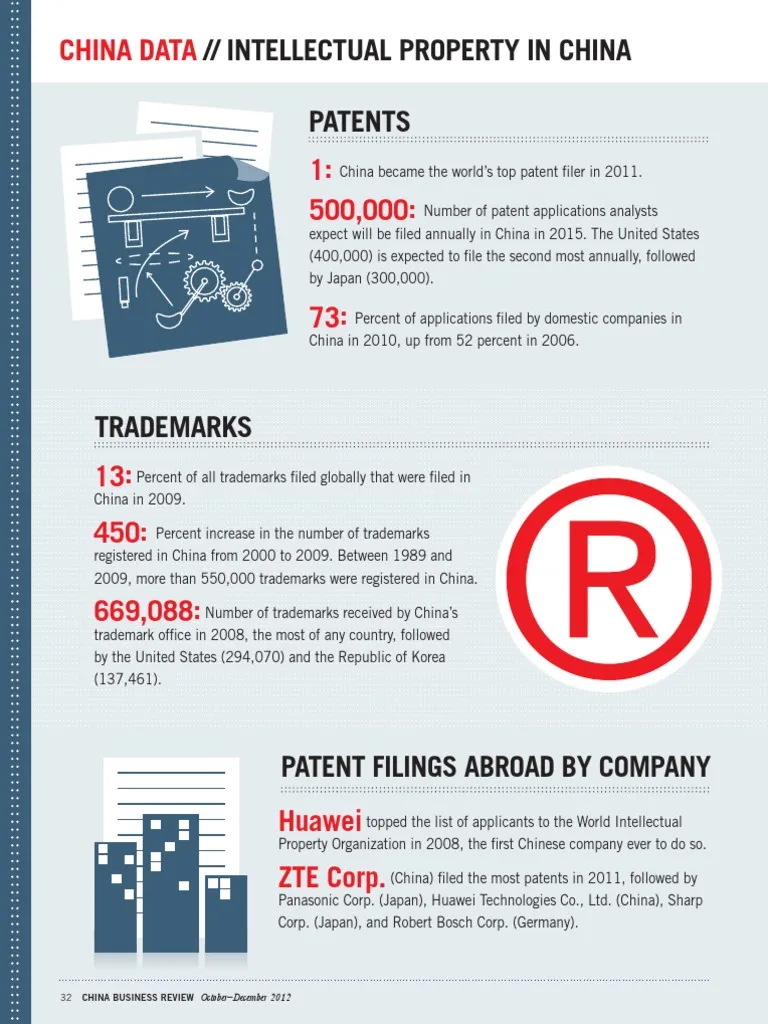
Photo: intellectual property legal documents technology patent China business, via imgv2-1-f.scribdassets.com
For years, intellectual property risk in China was treated as a binary condition among US business circles: either you accepted that your technology would be copied, or you stayed out of the market entirely. That framing was always an oversimplification, and in 2025 it is genuinely obsolete. The more accurate and actionable picture requires distinguishing between sectors, deal structures, enforcement mechanisms, and the motivations that now drive Chinese IP policy from the inside.
None of this means the risks have disappeared. They have not. But the nature of those risks has shifted considerably since 2015, and US companies that continue to rely on decade-old assumptions are making decisions on flawed intelligence. What follows is a current-state assessment — grounded in legal and operational reality — of where the landscape actually stands.
What Drove the Change: China's Internal Incentives for IP Reform
Perhaps the most important thing to understand about China's IP evolution is that it was not primarily driven by external pressure from US trade negotiations, though those pressures played a role. The more fundamental driver was domestic. As Chinese companies began generating their own valuable intellectual property — in areas like telecommunications technology, artificial intelligence, pharmaceutical research, and advanced manufacturing — the business community inside China developed a direct stake in a functioning enforcement system.
Huawei, for example, is now one of the largest patent holders in the world. Chinese pharmaceutical firms investing in drug development need patent protection to recoup R&D costs. The video game, software, and entertainment industries in China generate billions in revenue that depends on copyright enforcement. When the domestic constituency for IP protection becomes large and commercially powerful, the political calculus for enforcement changes. This is not an ideological shift — it is an interest-based one, and it is more durable for that reason.
The structural reforms that followed are real: China established specialized IP courts in Beijing, Shanghai, and Guangzhou beginning in 2014, with the Supreme People's Court adding an IP tribunal in 2019. Damage awards in IP cases have increased substantially. The volume of IP cases adjudicated annually in Chinese courts now exceeds that of any other jurisdiction in the world. These are not cosmetic changes.
Where Genuine Protection Now Exists
US legal practitioners who specialize in cross-border IP — including patent attorneys, trademark counsel, and technology licensing specialists with active China practices — generally point to several categories where enforcement has become meaningfully more reliable.
Trademark protection, particularly for registered marks, has improved substantially. The key qualifier is registration: China operates on a first-to-file system, meaning that a US company that delays registering its brand in China is vulnerable to trademark squatting regardless of how well-established the mark is in the United States. Companies that register early and maintain active monitoring now report reasonably effective recourse through both administrative and judicial channels.
Patent enforcement in technology and manufacturing contexts has improved, particularly in cases heard before the specialized IP courts. Several US technology companies and component manufacturers have successfully pursued infringement actions in Chinese courts in recent years — outcomes that would have been considered unlikely as recently as 2012. The specialized IP judiciary has developed genuine technical competence, and procedural predictability has increased.
Software copyright protection has seen meaningful improvement in the consumer and enterprise software segments, driven partly by China's own software industry's growth and partly by increased regulatory attention to software piracy in commercial contexts. That said, enforcement remains uneven, and the practical barriers to pursuing small-scale infringers remain high.
Where Significant Risks Remain
Candor requires acknowledging where the picture is considerably less reassuring.
Trade secret protection remains one of the most acute exposure areas for US companies operating in China. While China amended its Anti-Unfair Competition Law in 2019 to strengthen trade secret provisions, and criminal penalties for misappropriation have increased, the evidentiary and procedural challenges of proving trade secret theft in Chinese courts remain formidable. US manufacturers in sectors where process knowledge and manufacturing know-how constitute the primary competitive advantage — precision components, specialty chemicals, advanced materials — should approach technology transfer with particular caution and structure operations to limit exposure through compartmentalization rather than relying primarily on legal recourse after the fact.
Enforcement against state-connected entities remains structurally problematic. Even where the law is clear and the infringement is documented, pursuing IP claims against companies with strong government relationships — or against SOEs directly — presents challenges that domestic and foreign companies alike acknowledge candidly in private. The specialized IP courts have shown greater independence than general commercial courts, but the institutional constraints are real.
Geographical and sectoral variation is significant. Enforcement outcomes in Beijing, Shanghai, and Shenzhen tend to be more reliable than in smaller cities and provinces, where local protectionism can influence outcomes. Industries identified as strategic national priorities — semiconductors, certain AI applications, biotechnology — present heightened risk profiles regardless of formal legal protections, because the competitive stakes create stronger incentives for misappropriation.
How Experienced US Companies Are Structuring Their Exposure
US companies with sophisticated China operations have largely moved beyond the binary of "share everything" or "share nothing" toward a more granular architecture of IP management.
One approach that has gained traction among US manufacturers is technology segmentation: maintaining core process innovations and proprietary formulations outside of China-based operations while transferring only the production-stage knowledge necessary for manufacturing. This limits the IP footprint in China without forgoing the cost or market advantages of Chinese production.
In licensing and joint venture contexts, experienced practitioners consistently emphasize contractual architecture over trust. This means defining trade secret scope explicitly in contracts, establishing audit rights, specifying governing law and arbitration venues carefully — many US companies prefer Hong Kong or Singapore arbitration for China-related disputes — and building in contractual provisions that create deterrence value independent of court enforcement.
Proactive registration across all relevant IP categories — patents, trademarks, copyrights, and trade dress — before entering the Chinese market remains foundational advice that is still frequently ignored. The cost of comprehensive registration is modest relative to the exposure created by delayed or incomplete filings.
For software and technology companies, technical protection measures — including licensing architectures that limit functionality without active authorization, cloud-based service delivery that reduces the exposure of underlying code, and incremental release strategies that limit the value of any single point of access — provide practical protection that does not depend on enforcement at all.
The Honest Assessment
China's IP environment in 2025 is neither the lawless landscape of twenty years ago nor the reliable protection framework that some official narratives suggest. It is a system in genuine transition, with meaningful improvements in specific areas and persistent vulnerabilities in others. The US companies that navigate it most successfully are those that engage with the current reality rather than the historical caricature — registering IP proactively, structuring deals with legal architecture that creates real deterrence, segmenting technology exposure deliberately, and maintaining ongoing legal counsel with active China expertise rather than consulting it only when problems arise.
The risk is manageable. It requires management.